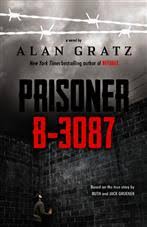
Bibliographic Information:
Author: Alan Gratz
Title: Prisoner B-3087
Copyright: 2013
Publisher: Scholastic Press.
ISBN: 978-0545459013
Summary: Yanek, a young Jewish boy living in 1930s Poland, his world gets turned completely upside down when the Nazis come in to take over his neighborhood. It started off small with the Nazis enforcing curfews for the Jews, forcing other Jews to live in their flat, and suddenly the antics of the Nazis got continuously worse with random raids and random people disappearing due to them being taken right off the street even his parents. Eventually this began to affect Yanek and his family with his parents being grabbed by the Nazis while they were coming back to buy bread. He himself was finally snatched one day while he was at work. Luckily he runs into his Uncle Moshe at one of the camps; however, he is killed one day. As a result Yanek is left to fend for himself as he goes from one concentration camp to the next, ten in total.
Critical Evaluation: The Author does a great job of capturing what it was really like for a child to live during WWII as well as what it was like to be in a concentration camp. A lot of critical details such as Yanek’s Uncle Moshe getting killed really without a logical explanation, groups of Jews being shot for fun, what would happen if the Nazis thought you were useless, and how the goal of everyday was simply to survive and keep moving, made the story very real. Some parts of the book seem dark and scary, but that was how life was back then during that time. The story is told in a way that it somewhat detached from what is going on concerning Yanek, but that gave readers a chance to really feel, see, and hear Yanek’s point of view on life. This is the first book that I have read concerning a first-hand account of an incident that occurred during the Holocaust that wasn’t about Anne Frank. Having told the story from a Jewish boy’s perspective, it sheds insight on his transformation from boy to a man, and how he had to make quick decisions for survival in order to simply get through the day such as: not saying anything, making sure to keep moving, etc.
Reader’s Annotation: Yanek has essentially lost everything: his home, his family, and is holding on by a thread for his will to live. Will he be able to survive the horrors of the concentration camps?
Author information: Many of Alan Gratz’s books have the topic of history in them. In his interview Gratz says that: “I love telling stories that have a basis in historical past”. He enjoyed taking looking for how to make a story out of a person’s life. He says that most people’s lives don’t make a perfect story. We don’t have natural clean beginnings, middles, and ends. He loves telling real stories.
He mentions how kids come back and tell him that they enjoyed his books “Prisoner”, “Samurai Short Stop” saying that they never would have been interested until I read your book. Also, the same kids who wrote letters to Gratz also mentioned that they went on to research more about the specific time period as well.
Genre: Historical Fiction
Curriculum Ties: Political Science
Book Talk Ideas: The Holocaust; Concentration Camps.
Reading Level/ Interest Age: Grades 9-12
Challenge Issues and Defense Preparation:
Selection Policy: http://ccclib.org/policies/CollectionDevelopmentAccess-1999-11-16.pdf
Library Bill of Rights: http://www.ala.org/advocacy/sites/ala.org.advocacy/files/content/intfreedom/librarybill/lbor.pdf
Right to Read:
http://www2.ncte.org/statement/righttoreadguideline/
Rationale:
Bibliographic Information: Author: Alan Gratz
Title: Prisoner B-3087
Copyright: 2013
Publisher: Scholastic Press
ISBN: 978-0545459013
Intended Audience: The intended audience is young adults specifically the upper grades of 9-12. This particular book would be beneficial for an English or social studies class. Primarily the book will be used for individual study in which every member of the class should read the book, and then afterwards there can be a group discussion of what transpired in the book as well as observations and thoughts concerning the book. “Prisoner B-3087” can be utilized to start discussions concerning the Holocaust, survivors of the Holocaust, and WWII.
Summary: Yanek, a young Jewish boy living in 1930s Poland, his world gets turned completely upside down when the Nazis come in to take over his neighborhood. It started off small with the Nazis enforcing curfews for the Jews, forcing other Jews to live in their flat, and suddenly the antics of the Nazis got continuously worse with random raids and random people disappearing due to them being taken right off the street even his parents. Eventually this began to affect Yanek and his family with his parents being grabbed by the Nazis while they were coming back to buy bread. He himself was finally snatched one day while he was at work. Luckily he runs into his Uncle Moshe at one of the camps; however, he is killed one day. As a result Yanek is left to fend for himself as he goes from one concentration camp to the next, ten in total.
Relationship to the Program: The relationship of the book to school objectives would be helping 9th graders develop their literal and inferential understanding skills and comprehension skills. Through reading this book they would learn SLE # R.9.9.1 Connect own background knowledge, including personal experience and perspectives shaped by age, gender, class or national origin, to determine author’s purpose. R.9.9.5. Draw inferences from a sentence or a paragraph (including conclusions, generalizations and predictions) and support them with text evidence. Concerning summary and generalization students will utilize R.9.9.8 Summarize and paraphrase structures in informational and literary texts, including relationships among concepts and details. Concerning analysis and evaluation students will utilize R. 9.9.11 Recognize and define various points of view (e.g., omniscient narrator, third person limited) and R. 9.9.13 Identify and discuss a position using concepts gained from reading (e.g. debate, discussion, position paper, etc.).
http://www.fayar.net/edvision/language/09_reading_0405.pdf
Impact: Students will be able to gain insight concerning what it was really like living as a Jewish boy during WWII. A lot of times, the main person that is discussed during the Holocaust is Anne Frank. This perspective reflects what life was like through a young boy’s eyes as he struggles to simply try to stay alive every day. Realistic details concerning this time period are shared such as losing family members, watching other people be killed at random, being worked almost to death, and what it was like for the survivors to have to march in the snow. This book will open up their perspectives concerning Jews living during WWII, and all that they truly endured.
Why Included: This book is amazing, for me it was like an action thriller movie, only in a book. It gives teens a real life looks at the Holocaust through the eyes of a young boy as he struggles to balance his newfound manhood, trying to stay alive every day, and trying not to lose hope as well as his sanity. The details in this book are raw and uncut. I like that aspect because then the readers can be exposed to the truth instead of modified versions of what really happened back then.
 Marlia's Blog