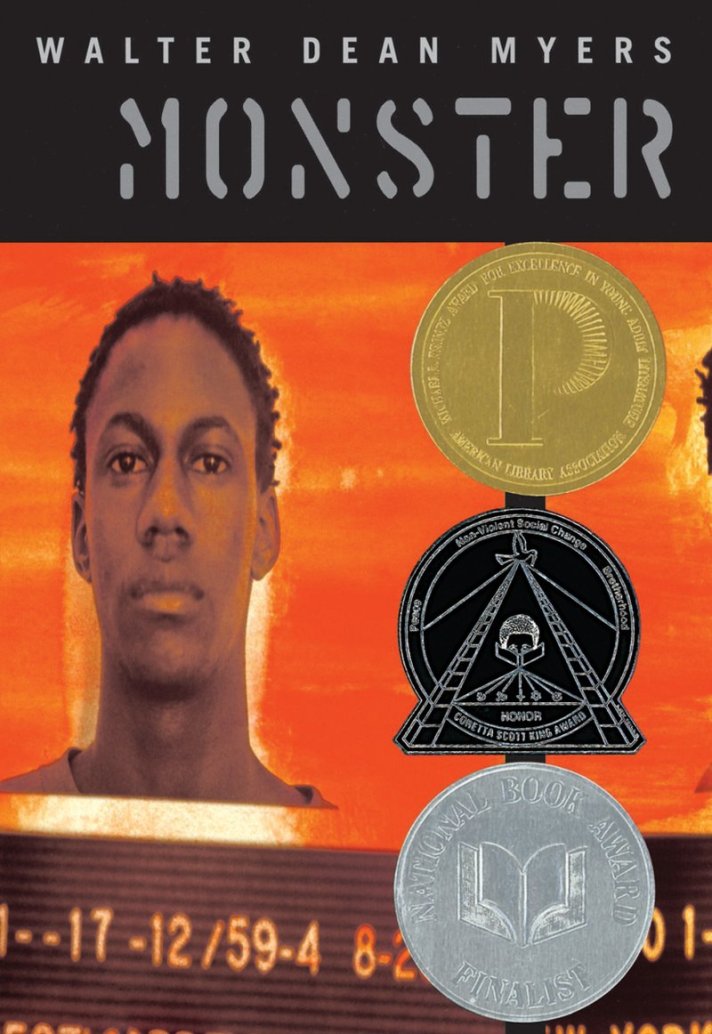
Bibliographic Information:
Author: Walter Dean Myers
Title: Monster
Publisher: Harper Collins
Copyright: 1999
ISBN: 9780064407311
Summary: This story focuses on the main character Steve Harmon, a sixteen year old from Harlem, who is on trial for murder. The situation seems simple: Steve and his codefendant James King went into a drugstore to steal money out of the cash register from the cashier which turns out to be the store owner. There was a struggle, in the midst of it one of the robbers tried taking the gun from the store owner, and the gun went off. As a result, the store owner was killed; the two robbers took the money and fled the scene. As the circumstances of the case are examined in greater detail, another suspect Richard “Bobo” Evans, who is already in prison on another charge, testifies confirming that King was his accomplice and Steve was a lookout for the robbery. But is that really what happened? Steve paints a different picture of the crime in which he didn’t assist in plan anything at all. There are three sides to every story: one side, the other side, and the truth. With a doubtful defense attorney, opposing testimonies, and everything to lose Steve struggles to tell his truth despite the odds.
Critical Evaluation: As a way to keep his mind occupied while awaiting trial, Steve starts writing a screenplay about his situation, telling the story of what happened from his perspective which is a unique feature of this book. Using script as a way to tell the story Steve becomes both the observer as well as a participant in the court case. The story is written in such a way that reader’s aren’t able to tell right away who exactly is telling the truth; even Steve struggles at times to figure out if he was guilty of being the lookout or not. The author forces the readers to be objective by presenting the facts and letting the readers be the jury. This is an extremely thought provoking story, and a large part of that is due to Steve being so complex. While he knows what he did and didn’t do, he constantly second guesses himself and his role in the incident. The author gives us an up-close glimpse of issues that young African American young men go through, being associated with the wrong people as well as being in the wrong place at the wrong time. Also the author’s portrayal of Steve proves that not every person that is deemed a criminal for their alleged actions is really in fact a monster; jails are filled with people who just simply associate with the wrong crowd and are in the wrong place at the wrong time.
Reader’s Annotation: As a sixteen-year-old, Steve Harmon should be doing teenage activities, like going to the mall, hanging out with friends, and doing homework, but instead he is on trial for being an accomplice to a murder. But did he really do it? You be the judge.
Author Information:Walter Dean Myers is an award winning African American author. Reading James Baldwin’s “Sonny’s Blues” inspired Myers to break into the writing scene. After briefly being in the army, he began to write seriously. He made it his personal mission to incorporate African Americans into stories since their characters and stories had been absent from books for so long.
Known as a prolific writer, Myers has won more awards than any other young adult author. “Monster” was the first winner of the Michael L Printz award, a New York Times bestseller, as well as a finalist in for the National Book Award. In 2009, he was selected to deliver the May Hill Arbuthnot Honor Lecture, which is an honor reserved for those specifically who have made important contributions to children’s literature. Myers received the Margaret A. Edwards award for lifetime achievement for his writings concerning young adults.
http://walterdeanmyers.net/about/
Genre: Fiction
Curriculum Ties: English
Book Talk: Incarcerated Youth
Reading/Interest Level: Grades 9-12
Challenge and Defense Preparation:
Challenge Issues: Justice System; Stereotypes of African American Young Men
Selection Policy: http://ccclib.org/policies/CollectionDevelopmentAccess-1999-11-16.pdf
Library Bill of Rights: http://www.ala.org/advocacy/sites/ala.org.advocacy/files/content/intfreedom/librarybill/lbor.pdf
Right to Read: http://www2.ncte.org/statement/righttoreadguideline/
Rationale:
Bibliographic Information:
Author: Walter Dean Myers
Title: Monster
Publisher: Harper Collins
Copyright: 1999
ISBN: 9780064407311
Intended Audience: The intended audience is young adults specifically the upper grades of 9-12. This particular book would be beneficial for an English or social studies class. Primarily the book will be used for individual study in which every member of the class should read the book, and then afterwards there can be a group discussion of what transpired in the book as well as observations and thoughts concerning the book. “Monster” can be utilized to create talking points for incarcerated youth and the justice system.
Summary: This story focuses on the main character Steve Harmon, a sixteen year old from Harlem, who is on trial for murder. The situation seems simple: Steve and his codefendant James King went into a drugstore to steal money out of the cash register from the cashier which turns out to be the store owner. There was a struggle, in the midst of it one of the robbers tried taking the gun from the store owner, and the gun went off. As a result, the store owner was killed; the two robbers took the money and fled the scene. As the circumstances of the case are examined in greater detail, another suspect Richard “Bobo” Evans, who is already in prison on another charge, testifies confirming that King was his accomplice and Steve was a lookout for the robbery. But is that really what happened? Steve paints a different picture of the crime in which he didn’t assist in plan anything at all. There are three sides to every story: one side, the other side, and the truth. With a doubtful defense attorney, opposing testimonies, and everything to lose Steve struggles to tell his truth despite the odds.
Relationship to School Objective: The relationship of the book to school objectives would be helping 9th graders develop their literal and inferential understanding skills and comprehension skills. Through reading this book they would learn and develop the following skills: SLE #R. 9.9.2. Identify specific ways an author accomplishes purpose, including organization, narrative and persuasive techniques, style, literary forms or genre, portrayal of themes, tone and intended audiences; R.9.9.4 Recognize how works of a given period reflect author’s background, historical events, and cultural influences; and R.9.9.5 Draw inferences from a sentence or a paragraph (including conclusions, generalizations and predictions) and support them with text evidence. Concerning summary and generalization students will utilize R.9.9.8 Summarize and paraphrase structures in informational and literary texts, including relationships among concepts and details and R. 9.9.13 Identify and discuss a position using concepts gained from reading (e.g. debate, discussion, position paper, etc.).Concerning analysis and evaluation students will utilize R. 9.9.11 Recognize and define various points of view (e.g., omniscient narrator, third person limited). http://www.fayar.net/edvision/language/09_reading_0405.pdf
Impact: I think this book has the potential to have a great impact on the students. Since the book is written in script, it forces the readers to observe rather than just make a decision prematurely without all the facts. This book provides a great example of how dangerous associating with the wrong people can be, and how being in the wrong place at the wrong time can definitely get a person into a lot of trouble. By making Steve such a complex character, it demonstrates to the students that just because someone is in jail concerning a crime “they committed” it doesn’t automatically mean that they are guilty or a monster.
Why Included: A lot of times when African American young men are sent to jail, they are often stereotyped by those that don’t know them well. Examples of how they are stereotyped include: assuming they come from bad homes, are troublemakers, are heartless, don’t care about the crime they committed, are scary, are mean and malicious. Sometimes the stereotype applies and sometimes it doesn’t. In this particular case Steve doesn’t fit the stereotype of African American men. I think it would be good for students to see that sometimes being associated or involved with the wrong crowd can have a huge negative impact on your life. Also, I would like for them to know that if they do find themselves in this type of situation then regardless of what anyone else thinks of them all that matters is their own opinion of themselves.
 Marlia's Blog